
Noticing the Stars and Planets
What Astrology Actually Is (and What It Isn’t)
Astrology is the study of the connection between the movements of the stars and planets and the patterns we see in human life. It is not fortune-telling.
It is not a system that controls you.
It is not about predicting exact events with absolute certainty. Astrology is a language. It is a way of noticing patterns between what is happening in the sky and what is happening in people’s lives, emotions, choices, and timing. For thousands of years, people in many cultures watched the sky and noticed that certain patterns in the heavens tended to show up alongside certain patterns in human experience. Astrology is the continued study of that relationship. because the Sky heavens and the stars have rhythms like all things in life and so do we. The natural world moves in rhythms. Day turns into night. Seasons change. The Moon grows full and then becomes dark again.Human life also moves in rhythms. We have times of energy and times of rest. Times of beginning and times of ending. Times when certain feelings or themes seem stronger than others. Astrology begins with a simple observation: the sky has cycles, and human life has cycles. Over a long time, people noticed that these cycles often move together in meaningful ways. This does not mean the planets force us to feel or do anything. It means there appears to be a relationship worth paying attention to — the same way we pay attention to the seasons when we plant, rest, or plan. which brings us to why most people misunderstand their birth sign in Astrology. Most people know Astrology only through their Sun sign. They say “I’m a Leo” or “I’m a Scorpio” and stop there. The Sun sign is important. It describes a core part of who you are. But it is only one piece of a much larger picture. A full birth chart includes many other factors: the Moon, the Rising sign, the other planets, and the areas of life they fall into. When someone only knows their Sun sign, they are looking at one chapter of a book and thinking it is the whole story. This is why many people say, “I don’t really relate to my sign.” Often it is because other parts of their chart are just as strong — or stronger — than the Sun. Today we begin to open that larger view.
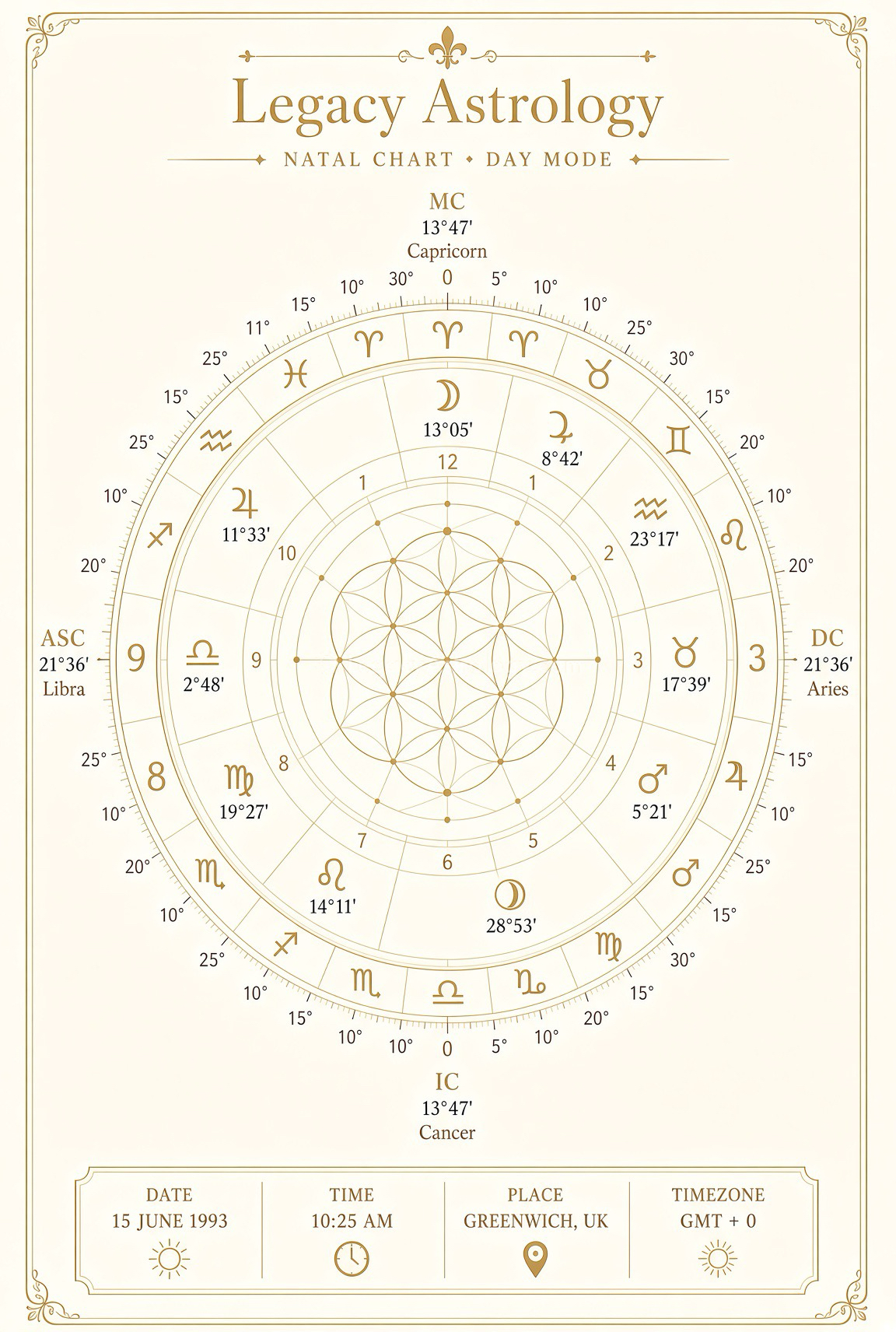
Your First Look at the Bigger Map A birth chart is simply a map of the sky at the exact moment and place you were born. It shows where the Sun, Moon, and planets were located at that time. That map becomes a symbolic picture of the patterns, tendencies, and potentials you carry. To create a birth chart, three things are needed:
- Date of birth
- Time of birth (as exact as possible)
- Place of birth
When we look at a chart, we are not looking for a fixed destiny. We are looking for a clearer understanding of the rhythms and patterns that tend to show up in a person’s life. Today we will look at a sample chart together so you can begin to see what this map actually looks like. The goal is not to memorize everything. The goal is simply to start noticing.
The Basic Toolset
The 12 Signs in Plain Language The zodiac is a circle divided into 12 equal parts. Each part is called a sign. These 12 signs are not rigid boxes that define who you are. They are more like different styles or flavors of energy. Each one describes a particular way of approaching life. Here they are in everyday language:
- Aries—Direct, initiating, ready to start
- Taurus—Steady, practical, values comfort and stability
- Gemini—Curious, communicative, moves between ideas
- Cancer—Protective, emotional, focused on safety and care
- Leo—Expressive, warm, wants to be seen and appreciated
- Virgo—Helpful, precise, pays attention to details
- Libra—Relational, seeks balance and harmony
- Scorpio—Intense, private, goes deep
- Sagittarius—Exploratory, honest, looks for meaning and freedom
- Capricorn—Responsible, structured, focused on long-term goals
- Aquarius—Independent, original, thinks about the bigger picture
- Pisces—Sensitive, imaginative, feels the emotional atmosphere
You do not need to memorize every trait. For now, it is enough to understand that each sign has its own natural style. The 12 signs are also grouped into four elements:
- Fire (Aries, Leo, Sagittarius)—energy, action, enthusiasm
- Earth (Taurus, Virgo, Capricorn)—practicality, stability, results
- Air (Gemini, Libra, Aquarius)—ideas, communication, perspective
- Water (Cancer, Scorpio, Pisces)—emotion, feeling, intuition
These elements help us understand the general tone of each sign more easily. so in a real sense, the planets are part of you and In Astrology, the planets represent different parts of human experience. Think of them as different functions or areas of life that everyone has. Here are the main ones in simple terms:
- Sun—Your core self, your sense of identity, what you are becoming
- Moon—Your emotions, your needs, what makes you feel safe
- Mercury—How you think, speak, and process information
- Venus—What you value, how you relate, what you find beautiful or pleasing
- Mars—How you take action, assert yourself, and handle desire or conflict
- Jupiter—Where you seek growth, meaning, and expansion
- Saturn—Where you meet structure, responsibility, and long-term lessons
The outer planets (Uranus, Neptune, Pluto) also matter, but for this weekend we will keep the focus on the ones above so the information stays clear and usable. Each planet shows a different part of you. When we look at a birth chart, we are looking at how these different parts are arranged and expressed. Now let’s talk about your big three sun, moon, and rising signs Most people only know their Sun sign. The next important step is to understand what many call the “Big Three.” Sun
This is your core identity. It describes the central themes of who you are and what you are developing throughout life. When someone asks “What’s your sign?”, they are usually asking for your Sun sign. Moon
This describes your emotional nature. It shows what you need in order to feel secure, how you respond emotionally, and what feels familiar or comforting to you. The Moon is often more private than the Sun. Rising Sign (also called the Ascendant)
This is the sign that was coming up over the eastern horizon at the moment you were born. It describes the way you naturally present yourself to the world and the first impression you often give. It also sets the structure of the entire birth chart. When you put these three together — Sun, Moon, and Rising — you already have a much fuller picture of a person than the Sun sign alone can give. Many people feel a strong sense of recognition when they learn their Moon and Rising signs for the first time. So now that you know that let’s talk about reading a simple birth chart together. A birth chart is a circular map. It shows where the Sun, Moon, and planets were located at the moment of birth. Today we will look at a chart together step by step. The goal is not to become an expert. The goal is to become familiar with the basic layout so it no longer feels mysterious. We will practice:
- Finding the Sun
- Finding the Moon
- Finding the Rising sign
- Noticing a few other planets in a simple way
As we look at the chart, remember: this is a map of patterns and potentials. It is not a fixed script. It is a tool for understanding. By the end of this session, you should feel more comfortable looking at a birth chart and recognizing the main pieces we have learned so far. But let’s talk about how these patterns sharpen our lives. Once you begin to understand the signs and the planets, the next step is learning to notice how these patterns actually appear in everyday life. You might notice that certain people move through the world with a very steady, practical style, while others are more spontaneous and fast-moving. You might notice that some people process emotions quietly and privately, while others express them more openly. These differences are often reflected in the birth chart. The value of Astrology at this stage is not about labeling people. It is about developing a clearer eye for patterns — in yourself and in others. When you can recognize a pattern, you usually have more choice in how you respond to it. Today we will practice looking at ordinary situations through this lens: how energy tends to move, how people tend to approach things, and how these tendencies can be understood more clearly with the language we have been learning.
Relationships, Timing & Decision-Making Astrology can be useful in three practical areas that most people care about: relationships, timing, and decision-making. In relationships, it can help you understand why you and another person may approach things very differently. It does not decide whether a relationship will work. It simply gives more information about the styles and needs that are present. In timing, Astrology can help you notice when certain kinds of energy are stronger or quieter. Some periods feel more natural for beginning something new. Other periods feel better for finishing, reflecting, or slowing down. This kind of awareness can support better pacing. In decision-making, Astrology does not remove your free will. It can, however, offer a clearer view of the tendencies and pressures that may be present when you are making a choice. That extra clarity can help you decide with more awareness. The goal is not to become dependent on the chart for every choice. The goal is to use it as one more source of useful information. Now here are some simple ways to keep learning without feeling or getting overwhelmed. It is easy to become overwhelmed once you start looking at Astrology online. There is a lot of information, and much of it is mixed with opinion, extremes, or unnecessary complexity. Here are simple guidelines for continuing in a grounded way:
- Stay with the basics longer than you think you need to.
- Focus first on your Sun, Moon, and Rising before adding more.
- Notice real-life patterns more than you collect new theory.
- Be cautious of content that speaks in absolute or fearful language.
- Give yourself permission to learn slowly.
You do not need to know everything in order for Astrology to be useful. A solid understanding of the basics is already more than most people ever develop. If you want to continue after this weekend, the most helpful next step is usually to keep observing your own chart and your own life side by side. Now here are some personal takeaways for you before we close. take a few minutes to reflect on what has been most useful for you over these three days. You might consider:
- What do you understand now that you did not understand before?
- Which part of the material felt most relevant to your actual life?
- What is one simple way you can continue noticing these patterns after you leave?
There is no single correct next step. Some people will want to go deeper into their own chart. Others will simply use what they learned this weekend as a clearer lens for understanding themselves and the people around them. Both are valid. The purpose of this introduction was to give you a clean, practical foundation — one that is useful in real life and free from unnecessary confusion. If you leave with that, the weekend has done its work.
I hope this helps you better understand. How do you utilize the tool system that has been waiting for you to understand it rest of the day you were born.
Enjoy everything may light clarity and understanding be with you always.
By Omarian ⚜ Atman
Founder of LegacyAstrology.com